Crypto Audit Tools
Comprehensive blockchain auditing capabilities including historical balance queries, transaction testing, and cryptographic ownership verification.
Historical Balances
Query wallet and smart contract balances from our integrated blockchains—whether you need balance data as of a specific historical date and time, a particular block height, or a mass query via .csv upload for thousands of addresses.
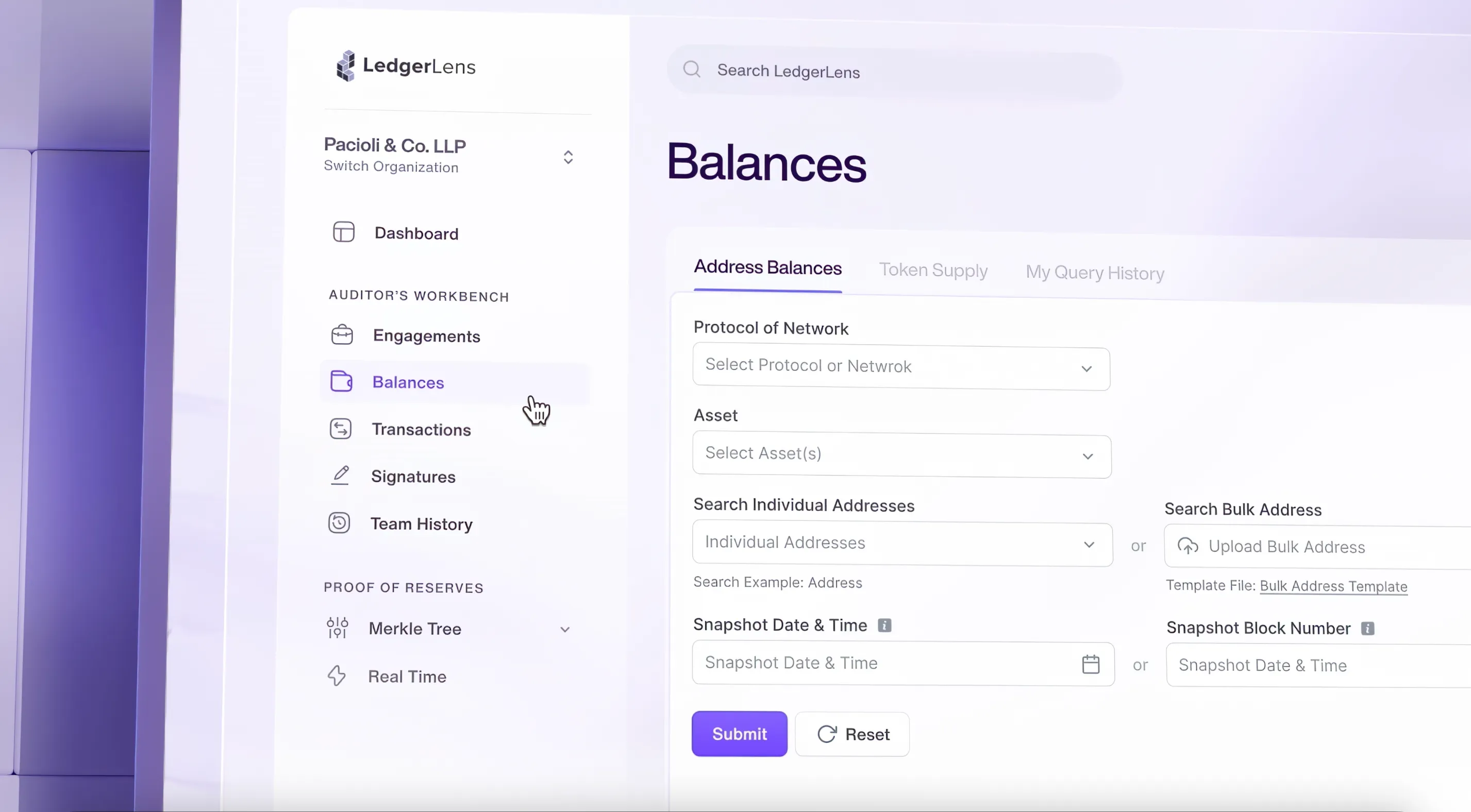
Query a single blockchain address by following these steps
Select Network
Choose the appropriate blockchain network (e.g., Bitcoin) and asset if applicable.
Enter Address
Enter the appropriate wallet address for the asset being searched. Ensure that the address is in a valid format for the selected network.
Set Search Parameters
Specify the query date/time or the block height.
Processing Query
The system displays the processing status along with the number of rows processed. On success, you'll see the balance, the query date/time, the block height, and a unique query ID. Query ID is stored for future reference for the audit team.
Key Features
Bulk Query (.CSV Upload)
Mass queries supported by uploading a .CSV file that contains a list of blockchain addresses
Smart Contract Token Supply Query (EVM Chains)
For Ethereum Virtual Machine (EVM) chains, you can also query the current token supply from smart contracts
Historical Query Log
All queries made through LedgerLens are recorded for future reference and auditing
Transaction Testing
The Transactions Module in the Auditor's Workbench enables you to query blockchain transactions by transaction ID or by address. In addition, you can review historical query data for your team's past activities.
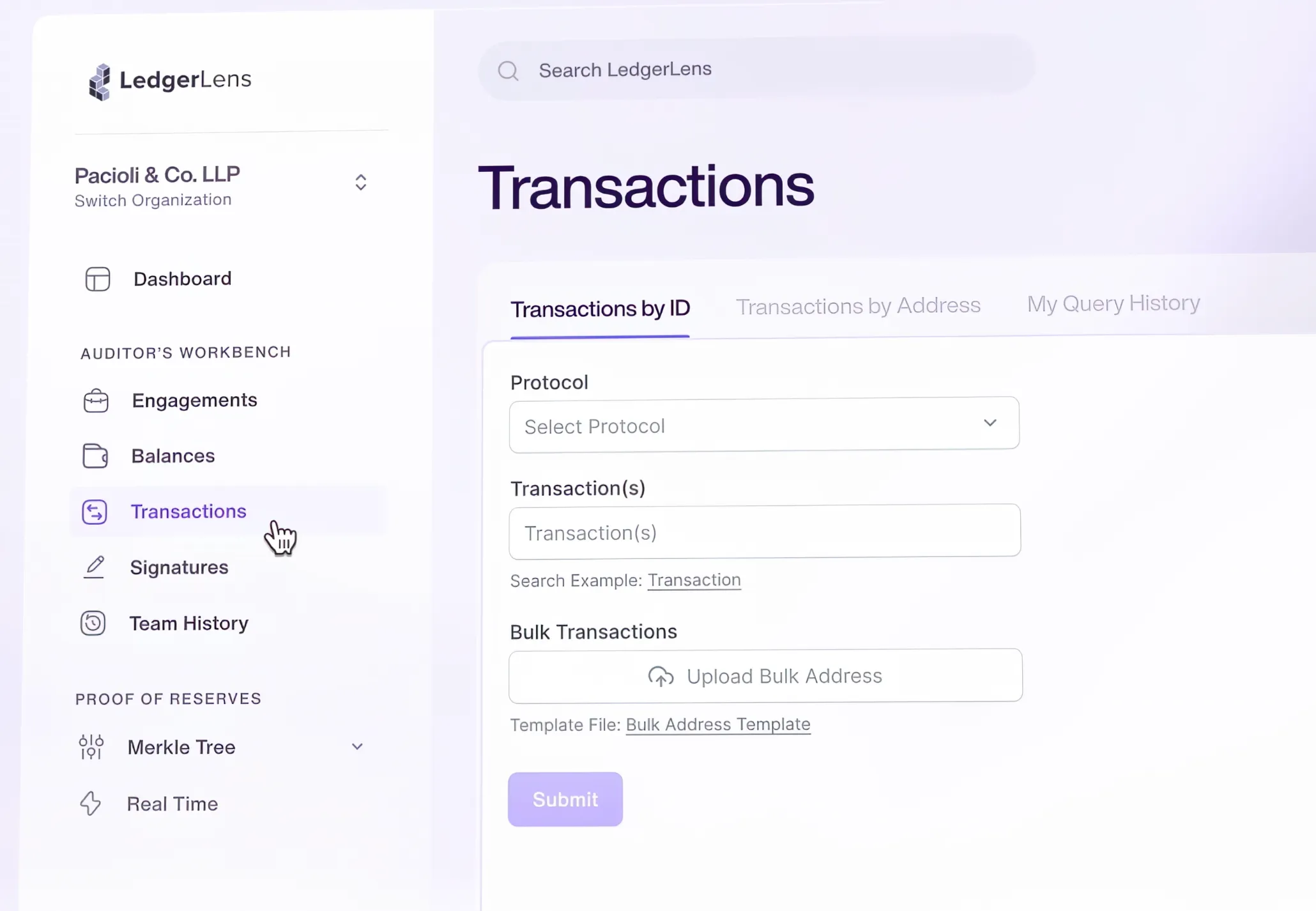
Watch how our streamlined process makes Bulk Transaction Query simple and efficient.
Upload .CSV File
Prepare and upload a CSV file listing multiple Bitcoin transaction IDs.
Processing
The system processes a set number of transactions (e.g., 25 sample transactions). Results include the transaction hash, block height, block time, and metadata detailing multiple outputs, transferred amounts, and transaction fees.
Download
Detailed results can be downloaded in CSV or JSON format for further analysis.
Additional Options for Querying Blockchain Transactions
Individual Transaction Query
Retrieve details for a specific transaction by its transaction ID.
Address-Based Query
Look up transactions associated with a particular blockchain address.
Historical Query Log
Access past queries for robust audit documentation.
Supported Protocols
Similar to the Balances Module, the Transactions Module supports both EVM and non-EVM chains, providing comprehensive coverage across the blockchain ecosystem.
Non-EVM Chains
EVM Chains
Ownership Verification
Built-in Digital Signature tools to test with cryptographic certainty
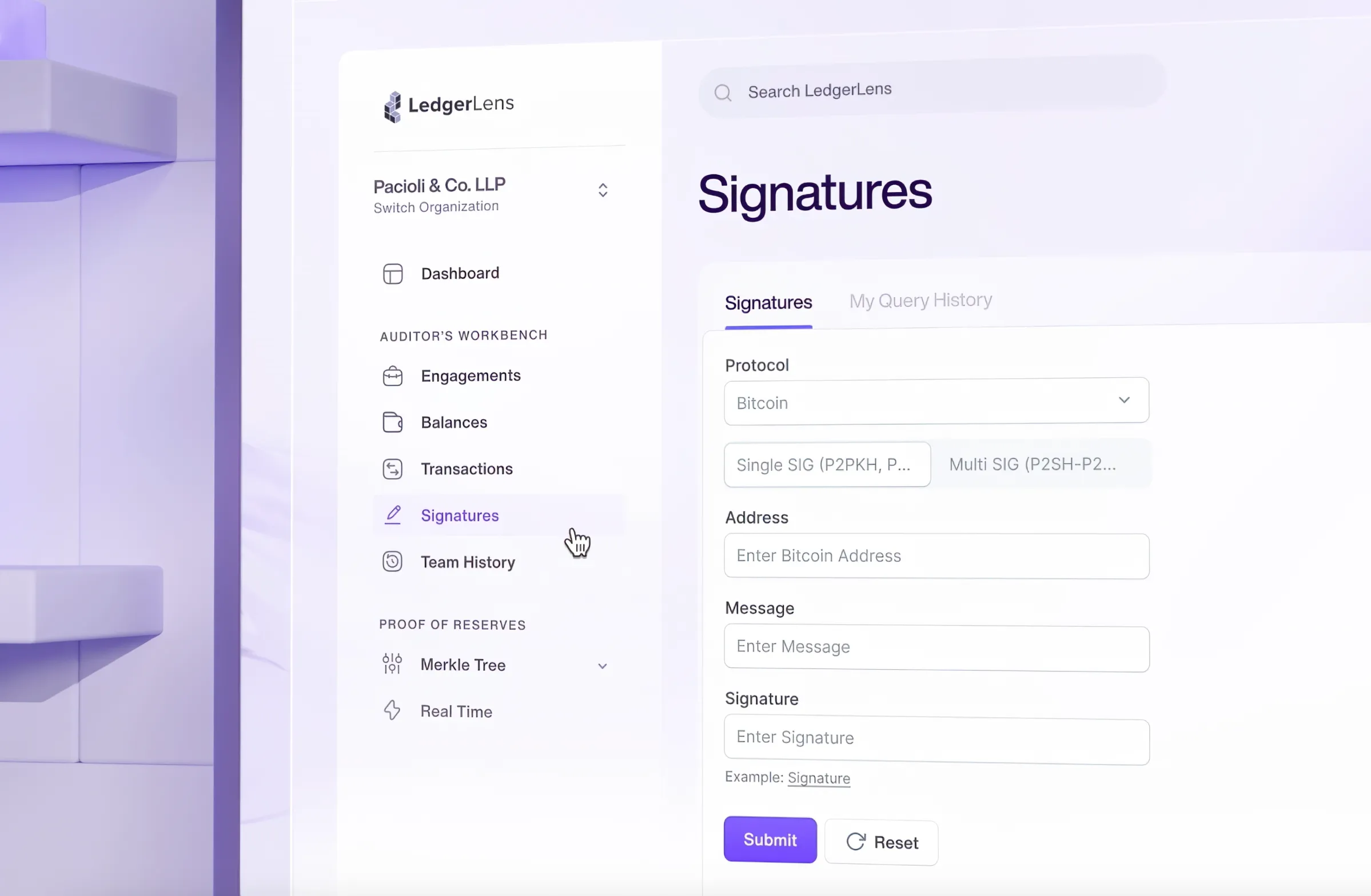
How It Works
Auditor Issues a Challenge Message
The auditor generates a unique message (e.g., timestamped string or audit session ID) that must be signed.
Entity Signs the Message
The entity uses the private key of the wallet to sign the message using the appropriate signing method for the blockchain
Auditor Verifies the Signature
The signed message is returned to the auditor, who uses the corresponding public address to verify that the signature is valid and matches the expected wallet.
Key Features
Cryptographic Proof of Control
Entities sign an auditor-issued challenge message with each wallet's private key, proving control without ever revealing the key.
No Sensitive Data Exposed
Verification relies only on public addresses and signatures, so private keys never leave the holder and no confidential information is shared.
Independently Verifiable
Anyone can re-verify a signature against the corresponding public address, so the evidence stands up to independent review.
Why It Matters
In blockchain-based audits, it's not enough to simply list wallet addresses. Auditors must confirm that the entity under audit actually controls those wallets. This is done by having the entity generate a cryptographic signature using the private key associated with each address — a process that can be independently verified without exposing any sensitive information.
Supported Chains and Methods
| Chain | Signing Method | Tools/Interfaces |
|---|---|---|
| Bitcoin | signmessage, PSBT | Bitcoin Core, Electrum, HWI |
| Ethereum | eth_sign, personal_sign | MetaMask, Ledger, Web3 providers |
| Solana | signMessage | Phantom, Solana CLI, Ledger |
| Others | Varies | Chain-specific SDKs or wallets |